
The Overlooked Amenity: How Thoughtful Laundry Choices Support Affordable Housing
By Blair Holt – President, Coin Meter | Nov 5, 2026
Editor’s Note: Coin Meter shared the following article in the Puget Sound Business Journal in November of 2026.
Affordable housing developers across the Puget Sound region face a constant tension: delivering the thoughtful amenities residents deserve while keeping operating costs sustainable. When combined with high-density urban infill development sites where every square foot counts, it creates a delicate balancing act. To thrive long-term, affordable housing communities must prioritize features that directly improve the quality of life for their residents without burdening already tight operating budgets.
The Puget Sound Business Journal Affordable Housing Forum brings leaders together this month, creating a timely opportunity to share solutions to complex challenges. Delivering affordable housing to our cities and neighbors requires every stakeholder, from city planners, lenders and housing authorities to architects, general contractors and specialty vendor partners, to come to the table with viable answers. If every player optimizes their piece of the puzzle, no matter how small, the compounding effect can improve a project’s long-term viability.
I am the third-generation president of Coin Meter. We have worked with local housing authorities, nonprofit developers and property management teams in Washington and Oregon for decades to provide shared laundry solutions. Laundry is a critical piece of a building’s daily operations, and when the room has the wrong size, placement or machine ratio, it can severely impact operational budgets, resident satisfaction and property stability. When we’re engaged early, we can help protect a property’s bottom line while making daily life better for residents. We’ve learned that the most successful projects are the ones where every vendor partner contributes a thoughtful, cost-conscious and resident-first solution.
Balancing In-Unit Desirability with Operational Reality
There is no question that in-unit washers and dryers are a major draw for residents, particularly in multi-bedroom units for families, seniors and people with physical disabilities. However, they can come at a heavy long-term operational cost.
In-unit laundry hookups average over 3.3 times the utility cost per unit compared to a centralized commercial laundry room. When considering the Puget Sound region’s utility rates, which are among the highest in the U.S. as providers have enacted consecutive rate increases, water and sewer bills could become one of an affordable housing project’s fastest-growing variable operating expense. The effect of this cost is compounded by the maximum rent limits placed on affordable housing projects. Those limits include the cost of utilities and make it difficult for property owners to recoup rising expenses.
Communal laundry rooms equipped with commercial-grade, high-efficiency machines use significantly less water, sewer and energy per pound of laundry when compared to in-unit sets that require smaller, more frequent loads. The centralized high-capacity machines allow residents to wash multiple loads at once, saving time while lowering building utility loads. Additionally, concentrating plumbing and electrical infrastructure into a single footprint significantly lowers routine maintenance costs and mitigates property-wide leak risks.
Using Technology to Enhance Equity and Convenience
Modern laundry technology eliminates traditional pain points without creating barriers to access for lower-income or unbanked residents. Issues such as multiple laundry room trips and bottlenecks in machine use can be alleviated with mobile app integrations, which allow residents to check machine availability in real time and receive completion alerts.
Payment flexibility is also essential to maintaining equity. When an affordable housing partner wanted to transition to a cashless building while continuing to subsidize resident laundry costs, Coin Meter implemented a reloadable smart-card system. Property managers automatically top off cards each month. This system delivers a direct and easy-to-use financial benefit to households while eliminating the risk of handling cash on-site.
Avoiding Costly Architectural Pitfalls
When partner input isn’t gathered in the blueprint stage, well-intentioned design choices can backfire. A common design trend is placing small laundry closets on every floor to minimize travel distance for residents. While thoughtful on paper, fewer machines per floor often result in long wait times for residents and higher utility costs for building owners. A single, optimized common laundry room for each building is almost always more efficient. It allows families to finish a week’s worth of laundry in the time it takes to run one load in an isolated closet.
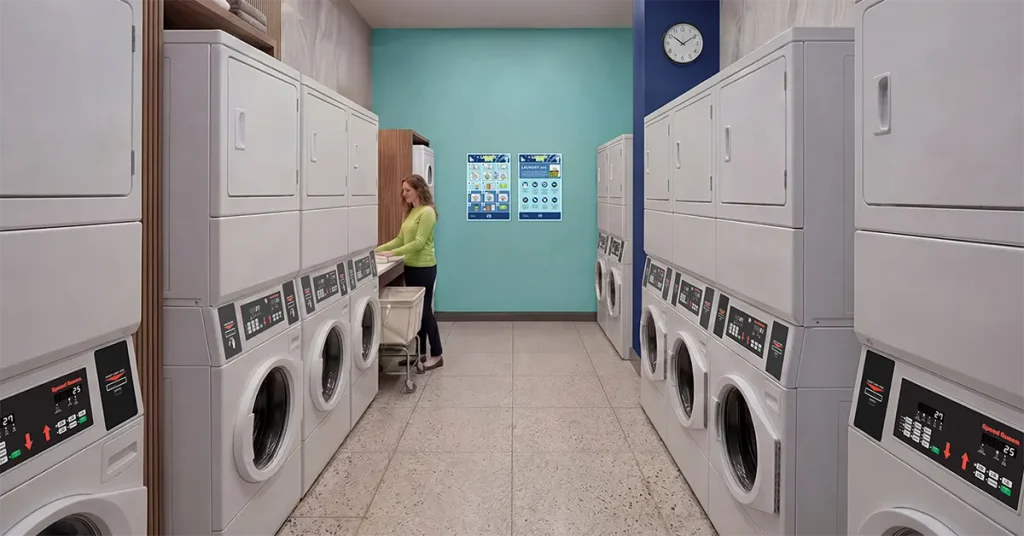
Opting for a common-area laundry room isn’t a compromise when done right. It’s a deliberate strategy to balance resident convenience with long-term financial health. Moving laundry rooms out of dark basements and onto upper floors with natural light, high visibility and added safety creates an inviting, functional space for residents. Incorporating flexible layouts with proximity to community rooms, free Wi-Fi and ample charging outlets also provides residents with opportunities to multitask and connect with neighbors.
Looking Ahead
Building a community that truly serves residents and families takes careful coordination across every project element. While laundry infrastructure is just one piece of the affordable housing equation, early design alignment can help properties thrive and support communities for years to come.
I am excited to join fellow regional leaders at the upcoming Puget Sound Business Journal Affordable Housing Forum to share practical solutions and explore how every stakeholder can help build stronger, more sustainable and affordable communities across the Puget Sound region.